GPT vs Gemini: Same Prompt, Different Universes
We fed the exact same cinematic prompt to GPT and Gemini. One delivered a movie still. The other delivered a mood board. Here's what that difference actually tells us about AI image generation — and why it matters more than you think.

AI Image Generation · Head-to-Head
There is a particular kind of disappointment that only the AI age can produce: you write a beautifully crafted prompt — structured, detailed, cinematic — and the model hands you back something that looks like it was designed for a corporate screensaver. Not bad, exactly. Just safe. Competent. Soulless. So in the spirit of science, curiosity, and mild chaos, we ran an experiment. One prompt. Two models. Zero mercy.
The prompt was unambiguous in its ambition: a young man leaning from a red helicopter over a rain-soaked rooftop helipad at night, a duffel bag spilling cash, city lights glowing in the background, dramatic cinematic lighting, motion blur on the blades, high detail, realistic shadows. Dark luxury. Action scene. The kind of brief a Hollywood production designer would hand a storyboard artist with the words: "Make it feel dangerous."
GPT and Gemini both read the same words. Both produced images. But what they produced reveals something fundamental about how these two systems understand the word cinematic — and whether they feel it, or merely know it.
Round One: The Atmosphere Test
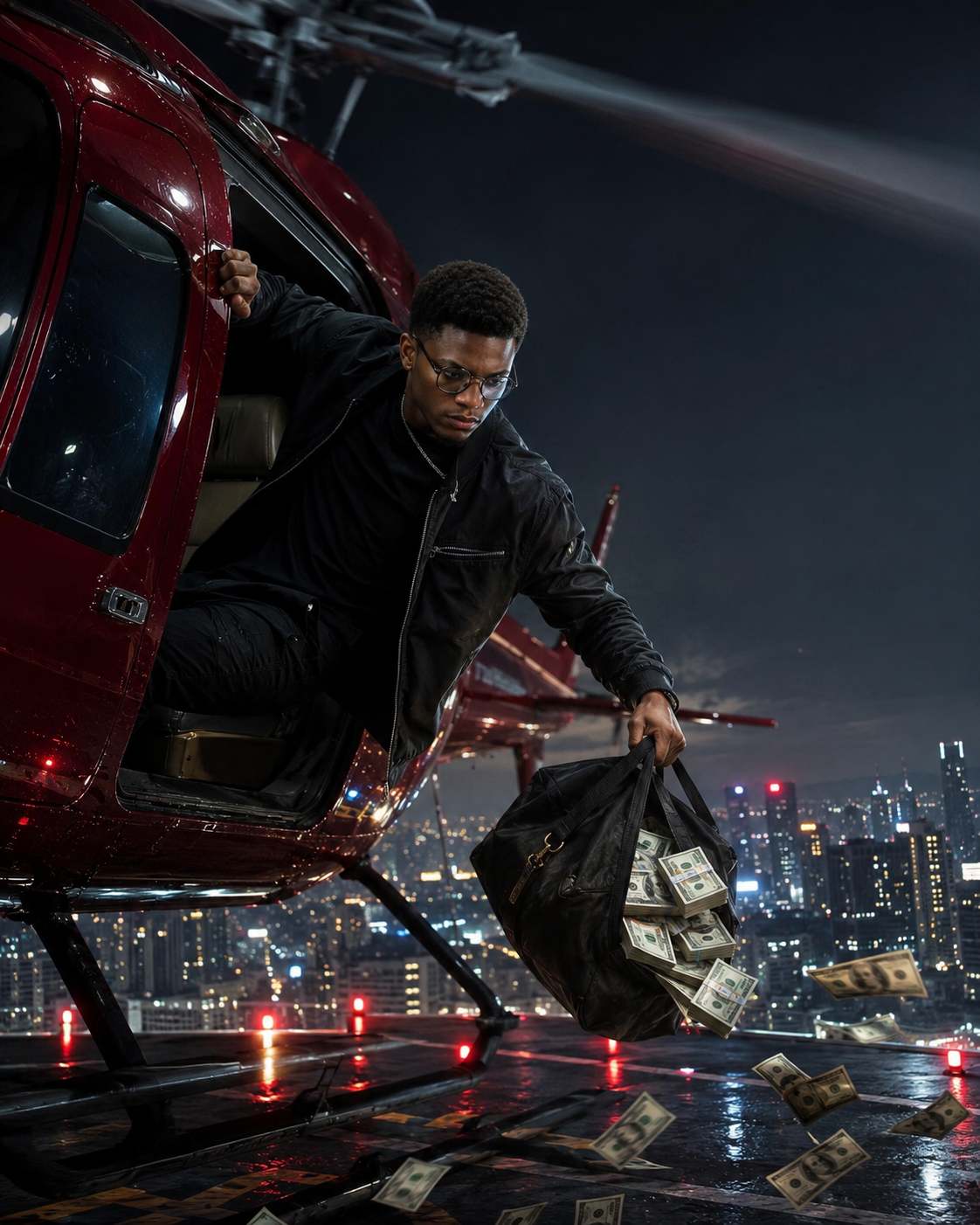
Open GPT's output and your first instinct is to check what film it's from. The shot is low and tight — a deliberate compositional choice that forces the subject to fill the frame, creating immediate tension. The helicopter's deep burgundy-red gleams with the kind of paint-job gloss that cinematographers light obsessively. The man leans forward with weight and intent, his black jacket catching rim light from the city below. Cash spills from the duffel onto the wet helipad, each bill catching a different angle of light. It is not just an image of a person near a helicopter. It is a moment.
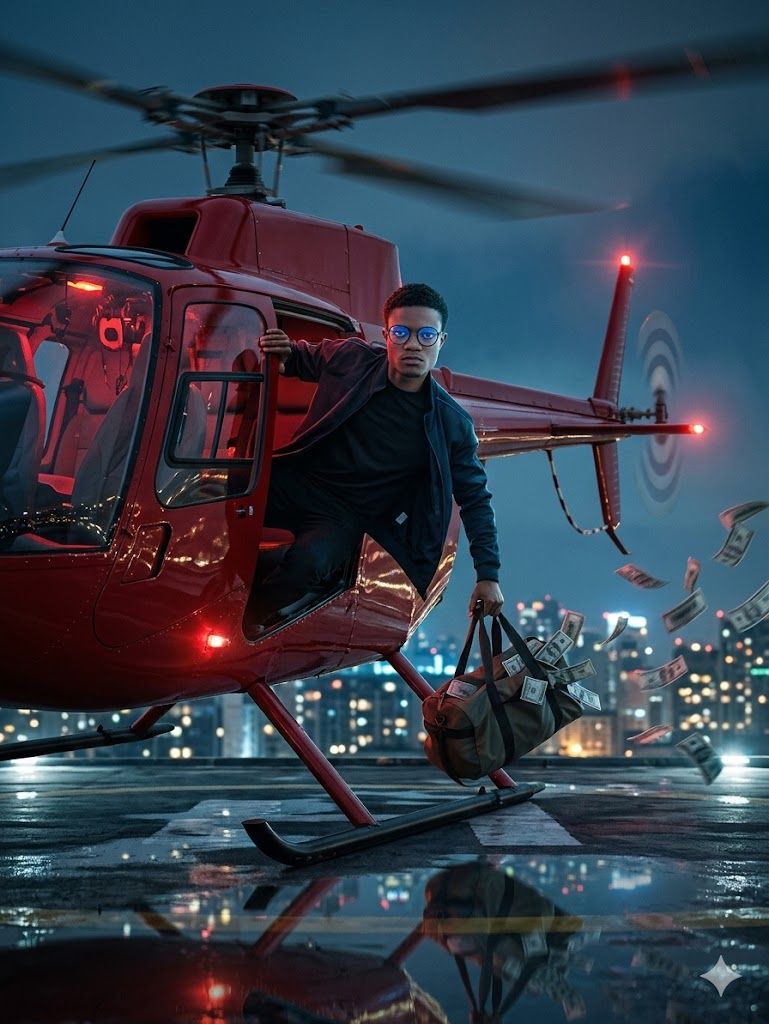
Gemini's version, meanwhile, is a perfectly pleasant piece of work — if the brief had been a luxury lifestyle campaign for an aviation startup. Wider frame. Brighter palette. The subject stands more upright, facing the camera directly like someone who just remembered it was picture day. The helicopter is cleaner, almost showroom-condition. Everything is well-lit, well-composed, and completely defanged of danger. Gemini looked at the words "dark luxury, action scene" and thought: stylish commercial.
GPT understood that darkness is not the absence of light — it is the presence of tension. Gemini lit the whole stage.
Round Two: The Technical Craft
Beyond atmosphere, the technical differences are just as telling. Let us go department by department, as a real director of photography would.
Lighting. GPT employs chiaroscuro — the centuries-old technique of using strong contrast between light and dark to create depth and drama. The subject's face is sculpted by shadow. The jacket folds carry genuine darkness in the creases. This reflects a model that has internalized cinematic grammar from an enormous body of film reference. Gemini's lighting is more diffuse, more even, more flattering. It is the kind of lighting used when you want everyone in the photo to look their best. It is, in short, the enemy of drama.
Motion and blur. The helicopter rotor in GPT's image has a natural, organic motion blur — the kind a real camera would capture at 1/60th of a second shutter speed. It feels physical. In Gemini's version, the rotor blur manifests as neat concentric rings, almost like a graphic design asset. Technically present, visually unconvincing. It is the difference between depicting motion and illustrating the concept of motion.
Surface detail. Look at the wet helipad in both images. GPT renders each puddle as a distinct reflective surface, catching the reds of helicopter lights, the blues of the distant city, the warm spill of interior cabin light. The reflections have logic. Gemini's helipad is also wet — the reflection is there — but it reads more uniformly, like a post-production effect rather than a physical surface. The water is decorative. GPT's water is real.
Round Three: What This Actually Means
Here is where it gets interesting — and where we move from critique to understanding. The gap between these two images is not primarily a gap in raw capability. Gemini is a highly sophisticated system. The image it produced is genuinely good. If you showed it to someone who had never seen GPT's version, they would likely be impressed.
The gap is a gap in interpretation philosophy.
GPT appears to treat cinematic descriptors — "dark luxury," "action scene," "cinematic atmosphere" — as emotional directives. It asks: what feeling should this image produce? And then it works backwards from that feeling to every technical decision: the angle, the shadow ratio, the focus point, the colour temperature. The result is an image that has a point of view.
Gemini appears to treat those same descriptors more literally and more safely. It delivers every element the prompt requested — helicopter, cash, city, night, rain — but assembles them in a way that is visually balanced rather than emotionally charged. It is the difference between a director who understands a script and a production assistant who has checked every item on the shot list.
The best prompt is not the longest one. It is the one that makes the model feel what you feel before it starts to render.
The Deeper Lesson for Prompt Engineers
For anyone building with AI, the takeaway is not simply "use GPT for images." The takeaway is that how you frame mood in a prompt matters enormously, and different models respond to different emotional vocabularies.
GPT responded to tone-first language: "dark luxury, tension, controlled chaos." These are feeling words, not instruction words. They assume the model has absorbed enough cinematic reference to translate emotion into craft. Gemini, by contrast, may respond better to explicit technical instruction — specify the exact lighting ratio, name the shadow depth, call out the colour temperature in Kelvin. Tell it to be dangerous, not just to look dangerous.
This is exactly the problem that tools like InputLayer were built to solve. The difference between a good AI output and a great one often lives entirely in the gap between what you meant and what you wrote. Prompting is translation. The better your translator, the closer the final image is to the one that existed only in your head.
Final Thought
We are living through the most remarkable moment in the history of visual creation. Two years ago, a prompt like the one used in this experiment would have produced something between a fever dream and a fingerpainting. Today, both images produced would pass for professional concept art in most contexts. The gap between them is the gap between great and very good — which is, as any creative director will tell you, the most interesting gap of all.
The models will keep improving. The prompts will keep getting smarter. The question — for creators, marketers, storytellers, and anyone who uses these tools to think visually — is whether you understand the machine well enough to tell it not just what to draw, but how to feel while it draws it.
GPT, at least for now, answers that question with a movie still. And sometimes, that is exactly what you need.